How a First Marathon Keepsake Earns Its Place on the Wall Years After the Race
A keepsake built from the runner's own GPS route lasts.
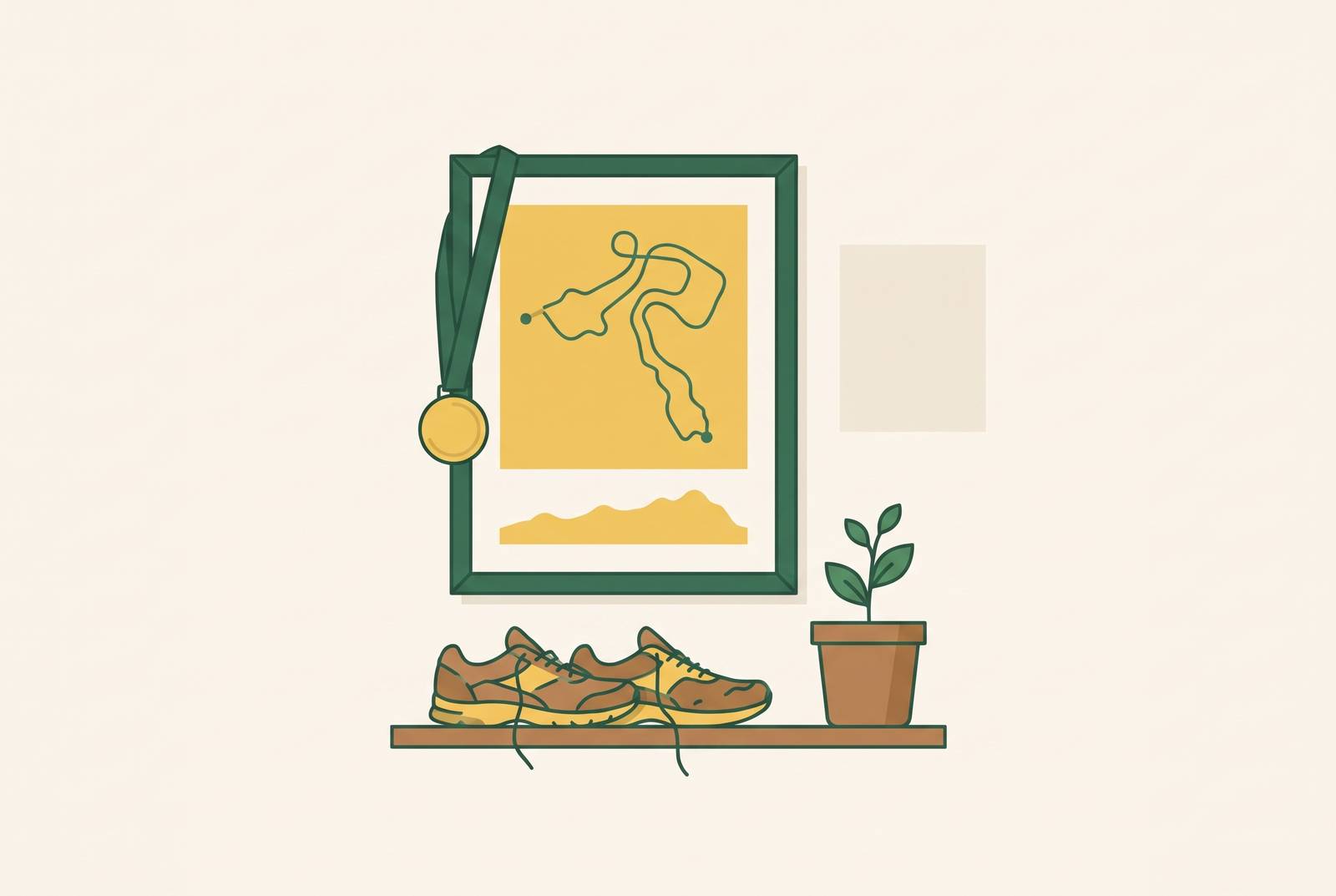
A thoughtful gift for someone who just ran their first marathon is a keepsake made from their actual GPS route, ideally with a record of the training that led there. A route print is the strongest starting point for wall display, while a handmade commission adds the significance of craft. The keepsake earns its place years later by preserving proof of the runner’s finish and transformation.
Why the first marathon feels different from every race that follows
The pride of a first marathon includes a discovery. The runner has done something they once doubted they could do. Unlike a personal best or a podium finish, its defining achievement does not depend on a comparison with another performance. The runner has crossed a boundary in their understanding of what they can undertake and complete. That is why the emotional weight of the day can exceed what a finishing time explains.
Early mornings, long weekend runs and missed social events made the commitment part of ordinary life over months. Each meant making time for something before the runner knew how it would turn out. For someone who loves that runner, the achievement also has this broader context. They know the finish belongs to a person whose sleep, relationships and use of time have been shaped by the buildup.
Later races can bring their own ambitions and rewards, but they begin with knowledge the first attempt could not offer. The runner already knows that completing a marathon is possible for them. The first finish establishes that foundation, which makes it different from an improvement built upon it. Yet the day itself passes quickly. A season of effort reaches its most visible moment in an experience too brief to contain everything that made it possible.
What the finisher medal actually represents — and what it cannot hold
The finisher medal gives the runner something they can hold onto from that moment. It is an acknowledgment of completion and of membership in the shared experience of a race. Its common design is part of its meaning. Every finisher receives the same emblem because each has completed the event it represents. A runner can cherish that recognition without expecting it to explain every private reason the finish was significant.
New York Road Runners’ 2026 TCS New York City Marathon medal shows how much deliberation can go into that shared object. Celebrating the 50th anniversary of the five-borough course, its design went through 26 initial concepts over a yearlong process. The zinc medal has an electroplated gold finish, measures 3.5 inches wide and is described as “a lasting keepsake of race day”. Its sculptural skyline and bridges connect the object to the city through which the runners travel. The design gives the race a distinct identity.
NYRR expects nearly 60,000 runners to cross the finish line at the 2026 event, each with a different history behind the same award. The medal cannot record the week one runner almost quit, the training miles logged in the dark or the reason they entered. Nor does its design contain the particular GPS trace of their race. A personal keepsake can therefore hold the runner’s own story from the shared race alongside the medal that officially marks their finish.
Why the training months are the part most at risk of being forgotten
Race day has a set date and a medal to remember it by, while the buildup stretches across a season of everyday life. Its texture includes weather, fear, disrupted schedules and small private victories that no one else witnessed. Those details are more varied than the fact of finishing. They are also less likely to remain distinct without something that anchors them.
Memory is reconstructive. Over time, the difficult weeks and familiar routes can collapse into a broad recollection that training was hard. That recollection preserves the feeling but loses the distinctions between one part of the buildup and another. A record of distances, routes or the progression of long runs gives those memories something concrete to return to. It retains the shape of the process rather than leaving only an impression of its difficulty.
This is also where the runner’s transformation took place. The finish made it visible, but the repeated work had already changed what the runner could do and what they believed they could attempt. A keepsake that includes training makes that less visible achievement available to view. The preparation deserves a witness of its own.
How GPS data turned a runner's exact route into something displayable
GPS data provides a way to make that private history visible without reducing it to a written account. A runner’s trace from Strava, Garmin or a GPX file can become the basis of wall art. The source is the recorded activity itself. Instead of choosing an image associated with a city, the runner can display the line recorded during their own movement through it. That changes the relationship between the image and the achievement.
A city-skyline poster identifies a place, while a GPS-sourced route identifies an activity undertaken by a particular runner. Two people who completed the same marathon on the same day can have different GPS tracks, pacing and route variations reflected in their prints. The distinction is not simply an added name. The underlying design comes from the runner’s record rather than from a shared illustration to which personal details are attached.
MRK Your Moment accepts Strava connections or GPX uploads for any route, providing one concrete example of how that record becomes displayable. A long run that defined the buildup can supply the image just as the marathon itself can. This gives the runner a choice about which part of the experience deserves visibility. The finish no longer has to stand in for all the work that preceded it, because the preparation has a visual record of its own.
What happens when craft is added to data — the case for embroidery and handmade work
The GPS trace establishes what an object records, but its material and method determine how that record takes form. A print makes the route visible as an image. Hand stitching turns the same line into stitches across a surface, so the work of making it becomes part of the finished piece. That distinction does not make a print less personal.
Irish artist Jennifer Madden makes this connection concrete. Her project involved running daily for one hundred days, then hand-stitching her Strava route over a painted canvas for each run. Running and stitching both depend on repetition, with successive small actions producing something that did not exist before.
Madden has also made work to order from other runners’ activities, including a three-piece set made from one runner’s Tokyo, London and Boston marathon routes. The route is the runner’s own, and the hand stitching gives it a look and feel of its own. Even if the route is run again, the new activity and the act of stitching belong to different moments. For a runner drawn to craft, that unrepeatable combination is part of the object’s value.
What makes a first marathon keepsake earn permanent wall space rather than a drawer
Specificity, training visibility and deliberateness of making distinguish a lasting keepsake from an interchangeable commemorative image. Specificity begins with the source material. An actual GPS trace shows where the runner ran, while a city graphic shows the place where it happened. A name and finishing time can make a template personally relevant, but they do not change where its central image came from.
A record of training miles, long-run progression or the weeks leading toward the start line allows the object to represent preparation as well as completion. That does not require every part of the buildup to appear. A meaningful training route can give an otherwise invisible part of the experience a place in the design. The distinction is between an object that marks the outcome and one that also records how the runner reached it.
Deliberateness concerns the making of the object itself. Care becomes part of the commission through hand stitching, made-to-order work and a process in which nothing is produced until the runner approves the design. These qualities connect the finished piece to considered effort rather than to the simple addition of personal fields. They also answer the strongest objection to personalized art. A commemorative piece can still feel generic if the runner’s contribution stops at a name and time.
Wall display is not the only expression of these qualities. Shorts embroidered from a runner’s GPS data, with the course on one leg and training weeks on the other, apply the same principles to a wearable object. They place the first marathon’s record within the training that follows. That alternative shows how a keepsake can preserve the right story through everyday use.
What should you give someone who just ran their first marathon — or choose for yourself?
For someone choosing their own keepsake, the GPS file from Strava or Garmin provides the raw material for the most specific options. A route print suits someone who wants a displayable image in a chosen size and format. A handmade commission suits someone for whom the time and craft involved in making the object are part of its purpose.
For a gift-giver, that dependence on personal data changes the process. The gift may mean more if the giver helps the runner create it than if they order and wrap it without the runner taking part. Inviting the runner to choose the activity allows them to identify the route that best represents what they accomplished. It also leaves room for a training run to have greater personal significance than the race map alone. Participation is part of the gift.
A GPS route print is a straightforward choice for a runner who wants wall art, and MRK Your Moment makes prints from routes as described above. A commission such as Madden’s suits a runner who wants their trace made into a piece of handmade work. Embroidered wearables suit someone who wants to wear their course and training record on the next long run. None of these formats is universally preferable. The useful comparison is between how each preserves the record and how the recipient wants to live with it.
The final test concerns what the object actually communicates. Would a stranger looking at it learn something true and specific about the runner, or only that someone completed a marathon? The latter can still be meaningful, as the medal demonstrates, but it leaves the individual history largely untold. Years later, the right keepsake offers a more exact point of return. The runner can look at the course they recorded or the training route they repeated and see physical proof that the work happened.