Gifts for Trail Runners vs Road Runners
How to match gifts to road and trail runners' different cultures.

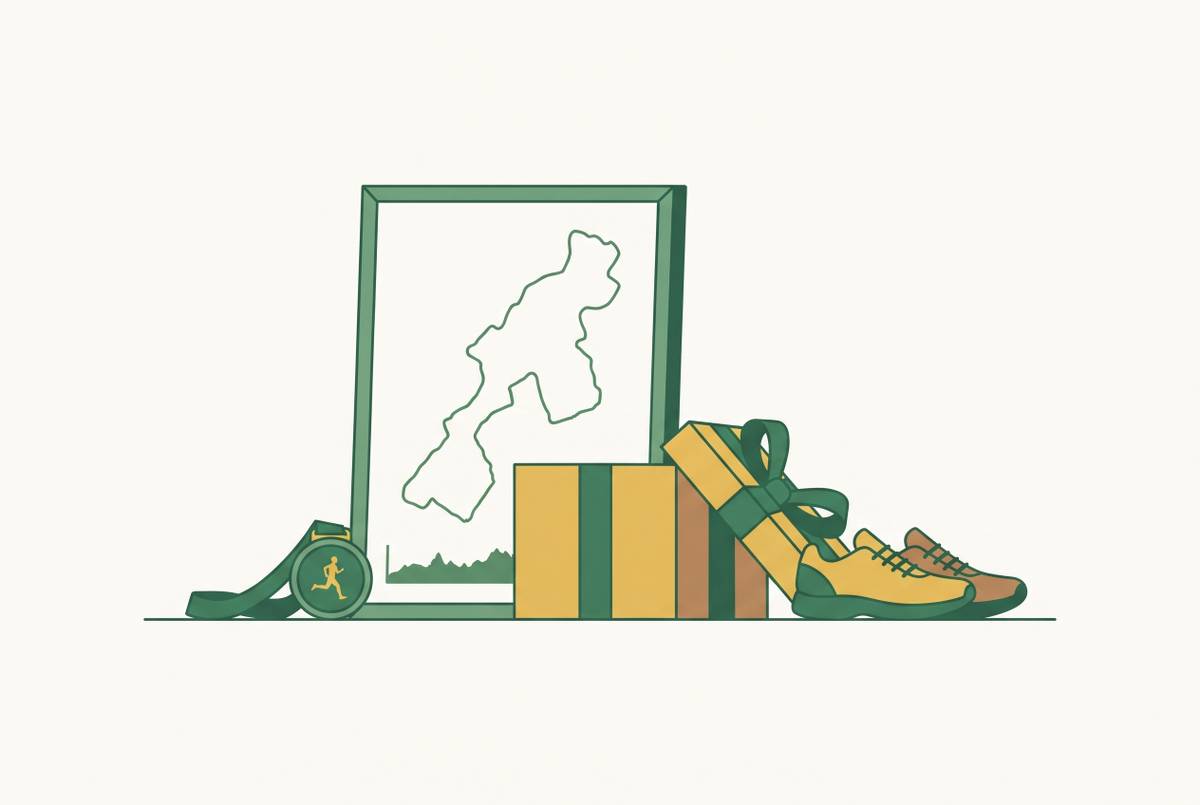
For someone who just finished their first marathon, a personalized route print with their name, race date, and finish time is a strong gift because it records their specific achievement. A road finisher may prize a recognizable course and a precise result, while a trail finisher may value a record of the terrain they crossed.
Why trail runners and road runners inhabit genuinely different cultures, not just different surfaces
Road running prizes legibility. Certified distances and split times let runners compare themselves with a field and with their previous performances. Trail running gives more weight to terrain, wilderness, and the experience of moving through a particular place. These are different definitions of a good run.
COROS’s runner data shows that road runners use a treadmill more than four times as often per year as trail runners. The same data shows that both groups do about the same amount of training, though trail runners tend to run more miles per week. Their seasonal rhythms also diverge, with trail runners reaching peak fitness in August after summer mountain blocks and road runners peaking in September. Equipment makes the contrast visible too. A road runner may leave with almost nothing, while a trail runner takes water, layers, nutrition, and emergency gear beyond the reach of convenience stores or bystanders.
How the road runner’s relationship with time and measurement shapes what a gift should do
A road runner’s training block is a countdown. Typically lasting around 16 weeks, it organizes pace and mileage around a fixed calendar date and a known distance. That structure creates two distinct gifting moments, with preparation before the race and recognition after it. Moisture-wicking socks or anti-chafe balm answer a recurring training need. Once the race is complete, however, the relevant detail is no longer what might help the runner finish but what they actually accomplished.
The Boston course or the Chicago course belongs to a shared running culture, so a route-based gift can be meaningful without explanation. Its geography identifies the event, while the runner’s name, date, bib number, and finish time identify the individual achievement within it. The gift’s emotional force comes from precisely recognizing this race.
That distinction makes a personalized marathon finisher gift more than a decorative object. A course print shows where the runner put in the effort, while a custom medal display gives the result a home beyond the medal itself. Neither has to help the runner do better next time. Their purpose is to preserve a completed achievement with the same specificity the runner brought to preparing for it.
How the trail runner’s relationship with place and self-sufficiency changes the gift calculus
Trail runners often train by time. Terrain and how much light is left shape the outing more than a steady pace does, while a vest, layers, and nutrition give runners what they cannot get along the route. A headlamp or hydration system therefore belongs to a culture of self-reliance. The practical gift acknowledges where the runner goes. It also requires care, because the wrong vest fit or shoe type can make an apparently useful purchase unsuitable.
Place-specific commemoration avoids much of that equipment risk. The route that matters most to a trail runner may follow a ridge system the giver has never heard of, one that is far less well known than a major marathon. That does not make it a weaker subject. A gift made from the actual GPS route identifies the landscape that gave the effort its character.
A topographic rendering can preserve ridgelines and elevation in a way that a simple route outline cannot. For smaller, self-timed, or unmarked events that give no medal, such an object also honors the finish in a way the event did not. Its value does not depend on other people recognizing the course. The obscurity is an advantage, because identifying that particular trail demonstrates attention that a generic finisher gift cannot.
Why finishing a race — road or trail — is a psychological event that changes what commemoration means
A race finish is a rite of passage. The training block prepares the runner, the race supplies the trial, and the return to ordinary life takes place with a new identity as a finisher. The marathon’s trial can include “the wall,” but its meaning extends beyond overcoming that moment. Runners describe the systematic training, the buildup of ability, and the eventual act of overcoming as parts of the achievement. Race day makes that accumulation visible.
New gear supports continued activity, while commemoration acknowledges a change that has already occurred. For some runners, the finish represents resilience or progress within a larger chapter of life. For others, running provides a way to channel grief into action. A gift should reflect what the finish means to that runner, since each finish can tell a different story.
The medal already serves as a ritual object. It is worn on the day and later displayed, but every finisher receives the same one. Personalization adds what the official medal cannot say about the runner, the course, and the training that got them there. Recognition of the preparation can be especially apt when the runner speaks more about the weeks of work than the race itself. This applies to both cultures, although acknowledgment may be rarer for a trail finish witnessed by almost no one.
The practical gift tier — gear that actually differs by terrain and culture
During training, it is fair to say that runners want gear more than art. Practical gifts work best when the giver knows what the runner likes and what problem the gift will solve. Body Glide Outdoor Anti Chafe Balm 1.5oz addresses chafing on long road runs, while a lightweight running hat with UV protection and a moisture-wicking sweatband addresses exposed conditions. The VeloChampion Triathlon Race Number Belt eliminates safety pins on race day.
For road training that does not require a full vest, the Nathan SpeedDraw Plus Insulated Handheld Bottle offers a handheld hydration option. The Gone For a Run Running Journal meets a different need with its running log, race log, and goals page. It fits the runner who values a record of progression.
Trail gifts instead need to account for light and self-sufficiency. The Fenix HL18R-T V2.0 is USB-C rechargeable and offers white, warm white, and red light modes. The Zelvot Running Vest with 2L Water Bladder holds water, nutrition, and layers, but it has to fit the runner. Run Forever Calf Compression Sleeves are an option for recovery after a run over uneven terrain with elevation gain. Such gifts serve work still in progress. After the finish, the stronger opportunity is to recognize what that work produced.
What is the best personalized gift for a marathon finisher using their actual route?
A GPS-based route print is a good choice for a gift that marks a particular marathon. It joins performance and memory through the geography of the effort. The same approach works for trail finishers, but the best format depends on what defined the route. A clean outline emphasizes the recognizable shape of a road course. A relief map gives physical form to the elevation and terrain of a trail.
For a giver choosing this category, the first step is to identify the exact course or obtain the runner’s GPS or GPX route data. The next is to select the details that make the record personal, such as name, finish date, bib number, distance, city, and time. The format should then follow the achievement. A famous marathon course suits minimalist wall art, while a route defined by ridgelines may call for a topographic object. Specificity comes before presentation.
“Personalised Marathon Route Map Print” uses GPS route data to create minimalist artwork of the exact course. “Any Run Custom Route Print” by Mark Your Moment offers a framed format covering named marathons including Paris and London. For terrain-led efforts, “Custom 3D Topographical Map Art | Framed Strava GPX Trail Relief Wall Decor” renders the actual trail in three dimensions and is listed on Etsy at $62.37.
Wearable keepsakes offer another destination for route data. Run2Wear translates Strava GPS data into minimalist artwork on everyday objects, including tote bags, water bottles, mugs, and premium tees. Made-to-order embroidered keepsakes can similarly incorporate a course, time, and training data. The distinction from wall art is use. A wearable record connects the completed race with the continuing practice of running, while a framed record gives the achievement a fixed place at home.
Medal displays and other post-race objects that hold a finish without replacing it
CelebrationMedals, a Canadian maker active on Etsy in 2026, produces custom holders incorporating the city, finisher year, race course, and two city/race designs into the base. Adding the runner’s name, finish date, bib number, or distance makes the display a record of what they achieved.
For a trail finisher without a medal, the role changes. A route canvas, name sign, or other custom commemorative object may provide the acknowledgment the event never supplied. It can be the medal moment itself.
These objects fit the days and weeks after a finish, when the runner is returning to ordinary life. The known result and available details allow personalization. That makes them lower-risk than equipment whose suitability depends on fit or established preferences. Their job is to hold the finish without pretending to replace the experience.
How to read which kind of gift a runner actually wants, and when to give it
Timing is the first decision, before product or format. Partway through training, a practical gift should solve a real problem on the terrain where the runner usually trains. During race week, the brief shifts toward low-footprint consumables such as familiar fuel, anti-chafe products, or socks, without changing established gear habits before a goal race. After the finish, preparation is complete, and the gift can commemorate the achievement.
The runner’s language supplies the next criterion. Someone who talks about splits and pace is offering specific measures that a course print or custom display can record. Someone who describes ridges, terrain, and where they were is identifying place as the central subject. A runner who talks most about training is pointing to a longer story. For that person, a keepsake acknowledging the buildup may be more accurate than one limited to the finish date.
A completed training block, an unsupported route, or a comeback run after injury can deserve a made-to-order record even when nobody awarded a medal. The best gift proves that the giver understood what this run meant to this person.