First Marathon Finisher Gifts That Mean More Than Another Medal Hanger
Personalized gift ideas that record a runner's own course and training.
The best personalized running gifts for first marathon finishers keep a record of the runner’s own course, race details, or training history, going beyond showing that they are a runner. GPS route art, race-specific embroidery, and displays combining a bib, photo, and medal make that distinction concrete. Recovery gifts offer a complementary form of recognition, acknowledging the physical cost of months of preparation as well as the finish.
Why a first marathon finish carries more weight than a standard achievement
Crossing a first marathon finish line brings relief, fatigue, and the resolution of months of doubt into a single moment. For the people watching, that moment is the achievement they can see. For the runner, it contains much more. The finish comes after early alarms, long runs in bad weather, and doubts that kept coming back about whether they could go the distance. It means so much partly because the runner knows how easily they might never have finished.
An ordinary gift can feel incomplete because so much of the work happened out of sight before the public finish. The people celebrating may have seen race day without seeing the decisions that made it possible. A finisher’s medal is given to every finisher, regardless of what reaching the line cost them personally. The medal is official recognition of completing the race, while a personal gift has room to acknowledge the individual who completed it.
A gift needs a point of connection to make that acknowledgment. A particular course, a race date, or a record of preparation can connect the object to an experience that otherwise remains largely private, which is the connection Laurels, a maker of made-to-order running shorts embroidered with the runner's own GPS race route and training data, builds each pair around. That connection is what separates recognition of a sporting result from recognition of the person behind it.
What the standard medal hanger actually does — and doesn't do
A standard medal hanger gives medals a place to hang and makes running visible in the home. That is a useful function, but a limited one. A generic running silhouette identifies the sport without identifying the runner’s experience. It says “runner” much as a trophy says “winner,” naming a category.
The distinction becomes clearer when the display is compared with the details the runner remembers. The race name locates the event, the date fixes it in time, and the finish time records the result of that particular effort. The course supplies the geography. These details prompt memories because they belong to the day itself. A hanger may support objects containing those details, but it does not add that specificity on its own.
Runners often report stronger attachment to their bib than to their medal because the bib physically covered the distance with them. Its number and race details also identify their participation directly. Display gifts can still be a good choice, but storing race objects and showing what they mean to the runner are different things. A meaningful gift should encode the specific runner, course, and journey.
How the training buildup shapes what the right gift should contain
Training for a first marathon usually takes many months, and a beginner’s weekly mileage roughly doubles before the taper. That progression changes what the finish represents. The runner has not simply completed a demanding day, but sustained an expanding commitment over time. A gift focused only on the result leaves most of that undertaking outside the frame.
The long run makes the scale of preparation concrete. It grows from about an hour to roughly three hours, developing endurance as well as pacing judgment, fueling practice, and experience of sustained effort. The work is not merely accumulating distance. It also involves learning how to manage that distance, with each longer effort demanding attention to more than the final mileage.
Nor is the build a straight ascent. Most plans have cutback weeks to help with fatigue, so stress and recovery follow a planned rhythm. Many first-timers do their longest single run three to four weeks before race day. That run often goes unnoticed by anyone else, well before people gather to celebrate the finish.
For a gift-giver, those details change what deserves to be preserved. Weeks of preparation, miles logged, and training routes can describe parts of the achievement that a finish time cannot. A print of the training record or a keepsake with GPS routes gives the runner something that shows that work. The purpose is not to assess the training, but to acknowledge that the undertaking began long before the start line.
What personalized marathon gifts preserve the actual course? GPS route art
GPS route art turns the course into the keepsake by converting the runner’s GPS or GPX data into a visual record. The print serves as both artwork and documentation. When the runner’s name and finish details are included, the print identifies whose effort the route records.
MrkYourMoment produces custom marathon route map prints directly from Strava GPX activity files, including race stats and elevation. It is a specific option for a gift centered on the course and its recorded details. My Adventure Maps also turns Strava or GPX data into personalized poster art and offers digital downloads that can arrive right away.
For a dimensional version, HaryPrint on Etsy offers a personalized 3D GPX route map in acrylic, plastic, paper, or wood. A GPX file is all that is needed. The distinction among these options is therefore not simply visual style, but whether the gift-giver wants a stats-led print, a digital poster, or a physical rendering of the route.
Start with access to the runner’s activity data through Strava, Garmin, or a GPX file. A course-based printed or framed piece can be ordered ahead when the race is known, while a record of the runner’s actual race activity necessarily follows the finish. Digital delivery reduces that wait, but it does not make finish data available before the race has happened.
Embroidered and wearable keepsakes that carry the race forward
A wearable keepsake offers the same personal connection in an object the runner can use. Its distinguishing feature is the detail stitched into it, including the city, year, distance, or runner’s name.
Etsy’s personalized embroidered marathon sweatshirt category includes “MARATHONER CHICAGO 2026” crewneck designs with the wearer’s name. That combination identifies both the event and the individual. A different approach echoes the format of a bib through the race name, number, and date. This draws on the bib’s personal significance without requiring the runner to put the original on a wall.
When production waits until the runner has finished, the completed achievement is what allows the object to exist. The gift follows the result rather than anticipating it. That relationship is especially fitting for a first marathon, where the runner has spent months working toward something not yet certain.
Wearable gifts also suit runners who like to use their keepsakes day to day. A race-specific piece can accompany them to a race expo or into their next phase of running. Some want the memory in view, while others want to wear it.
Shadow boxes, bib frames, and display options for runners who want to see the whole story
The bib identifies the participant, the route records the course, and the finish photo captures the runner at the event. The medal adds official recognition. Together, these elements preserve more of the experience than any one of them can hold alone.
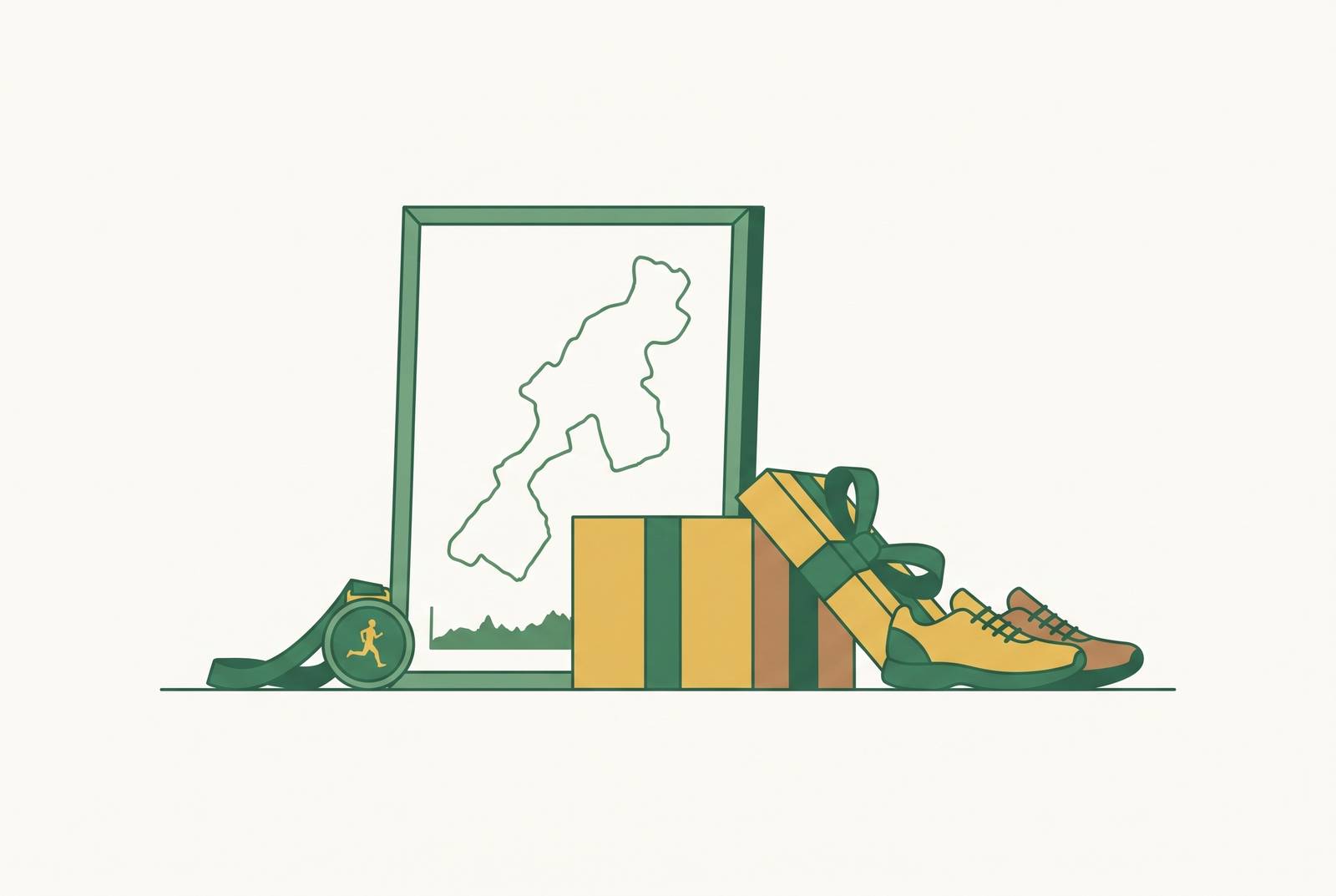
Framing Glory offers a Race Bib & Photo Display Frame from $61, with a choice of three wood frames and two mat board colours. It also offers a service to resize, print, and fit the photo, taking care of that part of putting the display together. Its Map, Photo & Medal Display Frame brings the route map, photo, and medal into one framed piece.
A shadow box also lets the runner keep several things from the race together. The gift-giver is curating a record. The best choice depends on what the runner has kept and what matters to them. A bib-centered display is particularly appropriate when the original race number is the object they feel most attached to, while a map-and-photo combination gives more space to the course and the finish.
Recovery gifts that acknowledge what the runner’s body just went through
Recovery gifts recognize the physical cost of the finish. After a marathon, muscles are fatigued, feet are sore, and the body needs time, hydration, and nutrition. The celebration does not end that need. A practical gift can acknowledge what comes next without asking the runner to turn immediately from one goal to another.
Massage guns, foam rollers, mobility kits, sports massage gift certificates, and yoga or stretching app subscriptions are options for this kind of care. Recovery sandals help with sore feet straight away by cushioning and supporting them. They recognize a specific discomfort at the point when the runner has stopped.
Timing is part of the consideration, too. A professional sports massage gift certificate, with the appointment booked a few days after the race instead of right away, shows that the runner needs time to recover after the finish-day celebrations. Epsom salt bath sets and wellness bundles give the runner another way to set aside time to rest. After months organized around training, permission to pause can be an appropriate gesture.
These gifts can stand alone or accompany a keepsake. A map or embroidered piece marks the achievement, while a recovery tool or experience attends to the person. The two need not compete for significance.
How to choose based on what you know about the runner
Specificity is the strongest criterion for choosing among these categories, but it must be matched to the recipient’s preferences. A highly detailed print is not automatically the best gift for someone who prefers wearable keepsakes. The object needs a place in their life. The decision begins with what the gift-giver knows about the race and ends with how the runner will want to remember it.
Do you know the course? If so, you can choose route art or an embroidered piece with the event’s name. Do you know the finish time, training weeks, or mileage? Those details support a data-driven keepsake, such as a training-record print or embroidered shorts, that can recognize preparation as well as race day. GPS data gives you the most ways to keep a record of the actual route, while a race-specific sweatshirt or a shadow box with the bib can still feel personal without that data.
Does this runner like to display things or wear them, or do they need help recovering right now? Lead time narrows the choice further, because embroidery and made-to-order pieces require planning, while GPS digital downloads can be gifted the same day and recovery gifts can be handed over at the finish line.
Price alone cannot resolve those questions. A detailed gift succeeds when its details are the ones the runner recognizes as their own. The finish line was shared with spectators and other finishers, but the early alarms, cutback weeks, and long runs were mostly private. A gift that preserves something of those months acknowledges more than the visible result. It gives the runner a record of work that few other people fully saw.