Running Gifts for Women Runners
Personalized keepsakes that capture her course and training matter more than gear.
A personalized gift for a marathon finisher should preserve her specific achievement. Running gifts for women runners are most meaningful when they connect the course, finish, or training block to something she can keep. A GPS route print suits a race she wants to display, while an embroidered keepsake makes that recognition wearable.
Why women runners are receiving more gifts than ever, and why most of those gifts miss the point
Before dawn, a woman heads out for a run. The quiet ritual precedes the demands of the day, with another stretch of training completed before most people see it. Yet the gift market answers that commitment with an abundance of largely interchangeable products. Amazon’s “gifts for runners female” category returns over 8,000 results, including socks, candles, foam rollers, and anti-chafe sticks. Volume is not the same as recognition.
These products may be well made. Many of these gifts meet a real need, especially when training gets hard. But they address the runner as an athlete whose body needs support rather than a person whose accomplishment has emotional weight. A useful gift can still leave that part untouched. The gap is between helping someone run and showing that someone understands what her running represents.
What actually motivates women to run, and why that changes what a good gift looks like
Research comparing women’s and men’s running motivations identifies weight concern, affiliation, self-esteem, psychological coping, and life meaning as more important motives for women than for men. That finding compares women’s and men’s motivations at the group level. Even so, it calls into question gifts chosen only to help a runner perform better. Running can meet needs for coping and connection that gear alone does not speak to.
For female novice marathon runners, affiliation, self-esteem, life meaning, and recognition are reported motivations for competing. Recognition deserves particular attention in a gift-giving context. It means being seen for an achievement by someone who understands the effort behind it. A finish time records an outcome, while a thoughtful gift can acknowledge why reaching that outcome was significant.
The distinction changes how a gift is judged. Its value need not depend on whether it improves pace, recovery, or comfort. For a runner whose finish represents months of doubt overcome, a specific keepsake can reflect that achievement back to her. This does not make every commemorative object meaningful. The connection to her reasons for running must be present, rather than supplied by a generic message about determination.
The training block as the hidden story behind every race
A marathon training cycle has an arc of its own. Early mornings become a routine, long runs grow longer, and weekly mileage builds toward a peak the runner may never reach again. Much of this work remains outside public view. Race day gives the effort a visible endpoint, but the training block rarely receives separate recognition. Its weeks disappear behind a finish photograph and a result.
Every Woman’s Marathon gives runners 8 hours to finish, longer than many other marathons, in recognition of the effort required to reach the start. The principle is straightforward. Pace does not show all that a runner put into getting there. A gift that records only the finishing result can therefore omit the part of the achievement that demanded the most sustained commitment.
Mileage, training weeks, and the route can give shape to work that otherwise remains in the runner’s memory. They also distinguish her experience from that of everyone who crossed the same finish line. The best commemorative gifts hold the whole story.
Practical gifts that support her training and are always welcome
Functional gifts earn their place by making training more comfortable, safer, or easier to sustain. For a runner mid-training-cycle, that can be the right purpose. Energy gels, chews, or sport beans provide easily digestible carbohydrates for runs over roughly 75 minutes. Anti-chafe options include Body Glide for Her, Squirrel’s Nut Butter, and Zone Naturals Chub Rub. Balega No Show technical socks help reduce blistering and sliding.
Gifts in the middle of the price range meet more specific running needs. TrailHeads convertible mittens switch from covered mitten to fingerless glove and include silicone grip palms and a reflective strip. Rollga offers a contoured recovery roller in soft, medium, and hard densities, while Trigger Point Grid is another option. Nathan Speedview Flask straps to the hand to avoid gripping fatigue and includes a zip pocket for a phone and keys.
Flipbelt provides stretchy, zipper-free storage for a phone and keys on shorter runs where a full hydration pack is unnecessary. SHOKZ OpenRun bone-conduction headphones allow music listening while preserving awareness of traffic. These are legitimate gifts. Their limitation is different, because equipment gets replaced and consumables disappear, leaving little to connect the gift to a particular accomplishment.
Gifts that hold the race itself — jewelry, keepsakes, and objects that mark what happened
Commemorative gifts have a different job from equipment. They give a specific race a lasting place in everyday life. Running bracelets with 5K, half marathon, or marathon distance charms show the milestone she reached, while 26.2 earrings get people talking about a marathon finish. Gold stainless steel necklaces with a female runner silhouette show that running is part of who she is. She can wear jewelry on a long run and at work without needing a place to display it.
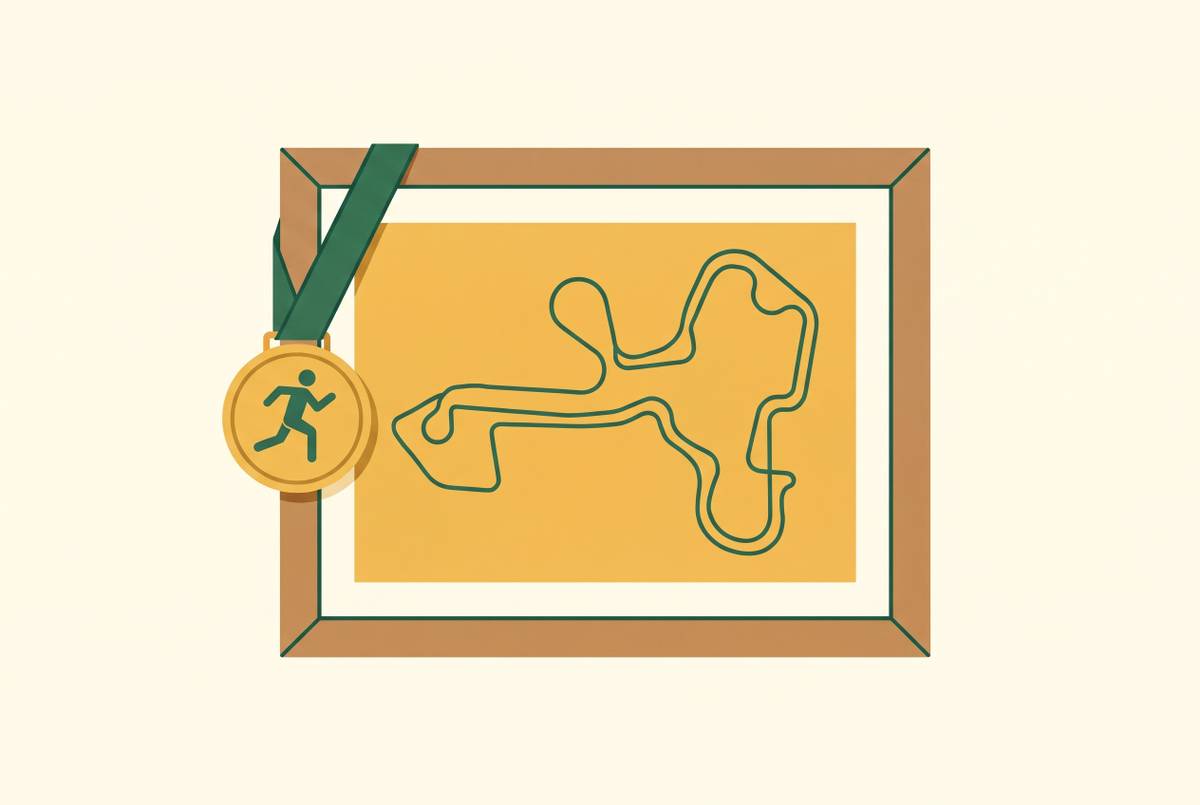
Bib and medal keepsakes make the event more explicit. Personalized race bib ornaments can include the race number, runner’s name, and marathon event date. Medal holders bring an achievement out of a drawer, while display frames can combine the official finisher medal with a course map print. Amazon lists personalized medal holders at a wide range of prices, from roughly $8 to $96 before discounts.
A distance charm shows the distance she reached, while a bib ornament shows who ran and at which race. Neither, on its own, records the route or the training that came before it. Even a medal frame with a course map needs more details to show the buildup. These objects preserve evidence of the race, but not necessarily the story of how she reached it.
GPS-data gifts that turn a runner’s route into a visual artifact
GPS-data gifts use the shape of an actual run in place of a general running symbol. A route synced from Strava, uploaded as a GPX file, or selected from a named course becomes a printed map, wall piece, or embroidered object. The source makes a difference. A named course identifies the event, while the runner’s own GPS record ties the object more directly to her activity.
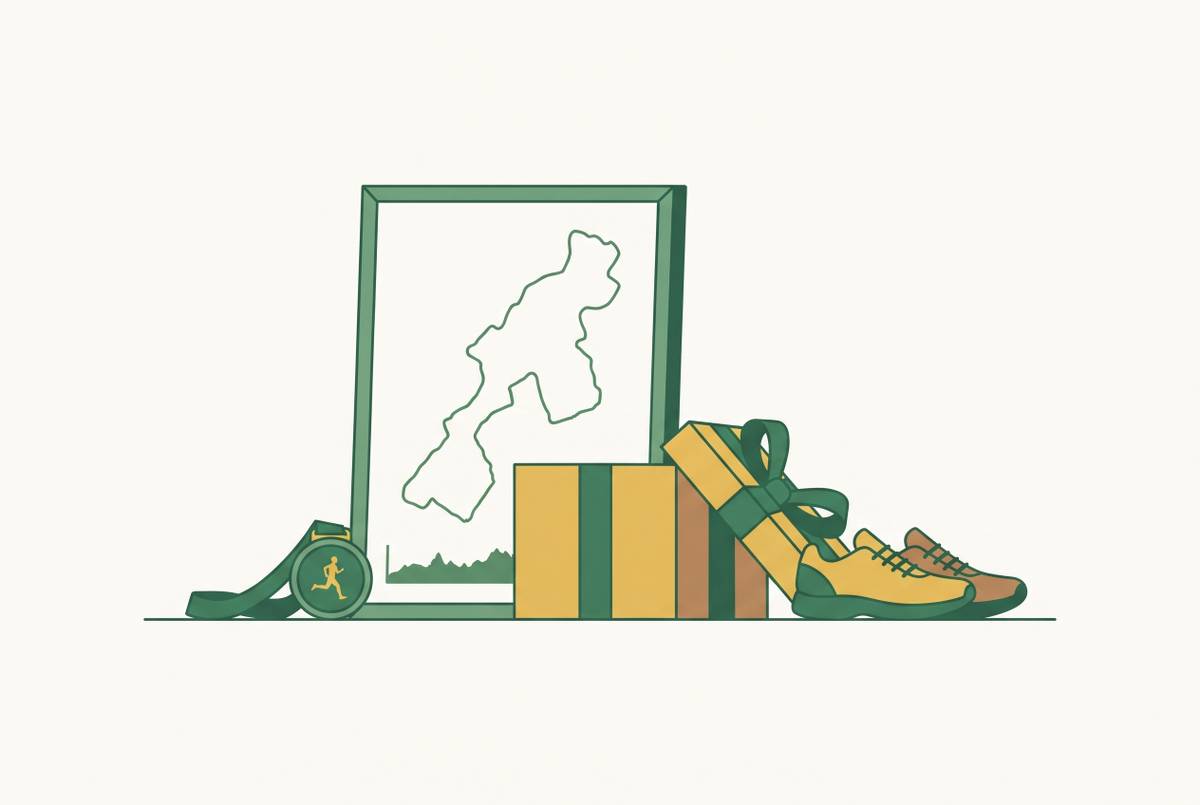
Mark Your Moment makes marathon route prints with precision GPS mapping, elevation profiles, and verified finish statistics, and also offers frames with a built-in medal display. RoutePrinter offers a dedicated runner gift line built around GPS route visualization. These options make the course itself the central image. The turns and finish chute replace the interchangeable silhouette of a runner. A print can therefore distinguish one marathon from another even when the distance is identical.
For a gift-giver choosing this category, the practical starting point is the route source. Next, choose the details the object should preserve, including the finish statistics or an elevation profile where offered. For a training-focused gift, mileage and weeks deserve attention alongside the finishing time. The useful comparison is how well the customizable fields describe the achievement being honored.
Judging a route print by its effect on the next race assumes that performance support is its purpose. For a runner who regards the finish as a life event, the object instead preserves a visible record of something personally significant. The closer its details come to her actual route, time, and miles, the less the gift depends on a generic congratulatory message.
Embroidered wearables that stitch the race into something she runs in next
Embroidery moves the commemorative image from a wall onto fabric. A stitched route or race detail can become part of something the runner wears. However, fabric alone does not make an object wearable. The distinction between a textile artwork, a patch, and a garment remains important when choosing the gift.
Etsy offers embroidered race maps, including a Chicago Marathon route stitched on fabric, with one example priced at $90. Custom embroidered patches can be sewn onto apparel, bags, or accessories to mark a marathon achievement. These are genuine alternatives for different uses. A route artwork keeps the course central, while a patch lets the commemoration become part of another object. Neither requires a generic finisher design to do the work of recognition.
Personalized marathoner sweatshirts offer another expression of the category. One Etsy example displays “MARATHONER CHICAGO 2026” on the chest, with a laurel wreath, “26.2,” and the runner’s name on the sleeve cuff. A bestselling version with more than 1,800 reviews is priced at $36. This identifies the event, distance, and individual, though it does not itself record the training block.
In a made-to-order process with proof approval, the design is settled before production begins. That gives the gift-giver or runner a defined point at which to approve the personalized object. The distinction from a poster is then practical as well as visual. An embroidered wearable can return to the road with the runner, keeping the memory connected to the activity that created it.
What should you get someone who just finished their first marathon, made a comeback, or completed unseen training?
For a first marathon finisher, a GPS-data print or embroidered keepsake of that first course is a strong personalized choice. It records a threshold she cannot cross for the first time again. Distance-specific jewelry, including 26.2 or 13.1 designs, offers a more compact way to make the milestone visible. The choice comes down to keeping a record of that course or showing the distance she ran.
For an experienced runner, the distinguishing feature may be a new course, a new PR, or a new city. A course-specific poster or embroidered item can mark that race without duplicating gear she already owns. A comeback calls for a related judgment. If the return itself is the achievement, the gift’s emphasis belongs on that race and the buildup rather than an assumption that the finishing time tells the whole story.
When the training was the hardest part, the weeks deserve explicit recognition. Gifts that include training mileage, weeks, or long runs together with the route preserve information that a race-only keepsake omits. A wooden yearly running log counter or a Believe Journal is another easy way to honor the training she keeps doing. These gifts give her credit for keeping at it, even without a finish line. They suit the work that received little attention while it was happening.
For a runner motivated by connection, an individual result may not be the central memory. A “sole sister” design, team gift, or group-training keepsake can acknowledge the shared experience instead. Affiliation is not a secondary concern simply because it does not appear in race statistics. The gift should reflect the runner’s reason for valuing the milestone. Budget comes after that decision.
What makes a running gift worth giving — and worth keeping
A useful gift choice considers both what she needs for the next run and what she should have to remember this one. The race may be over, but the work that made it possible deserves a longer life than race day.