What to Give Someone After Their First 26.2 That No Generic Running Store Carries
Personalized keepsakes transform race memories into objects that honor months of invisible training.
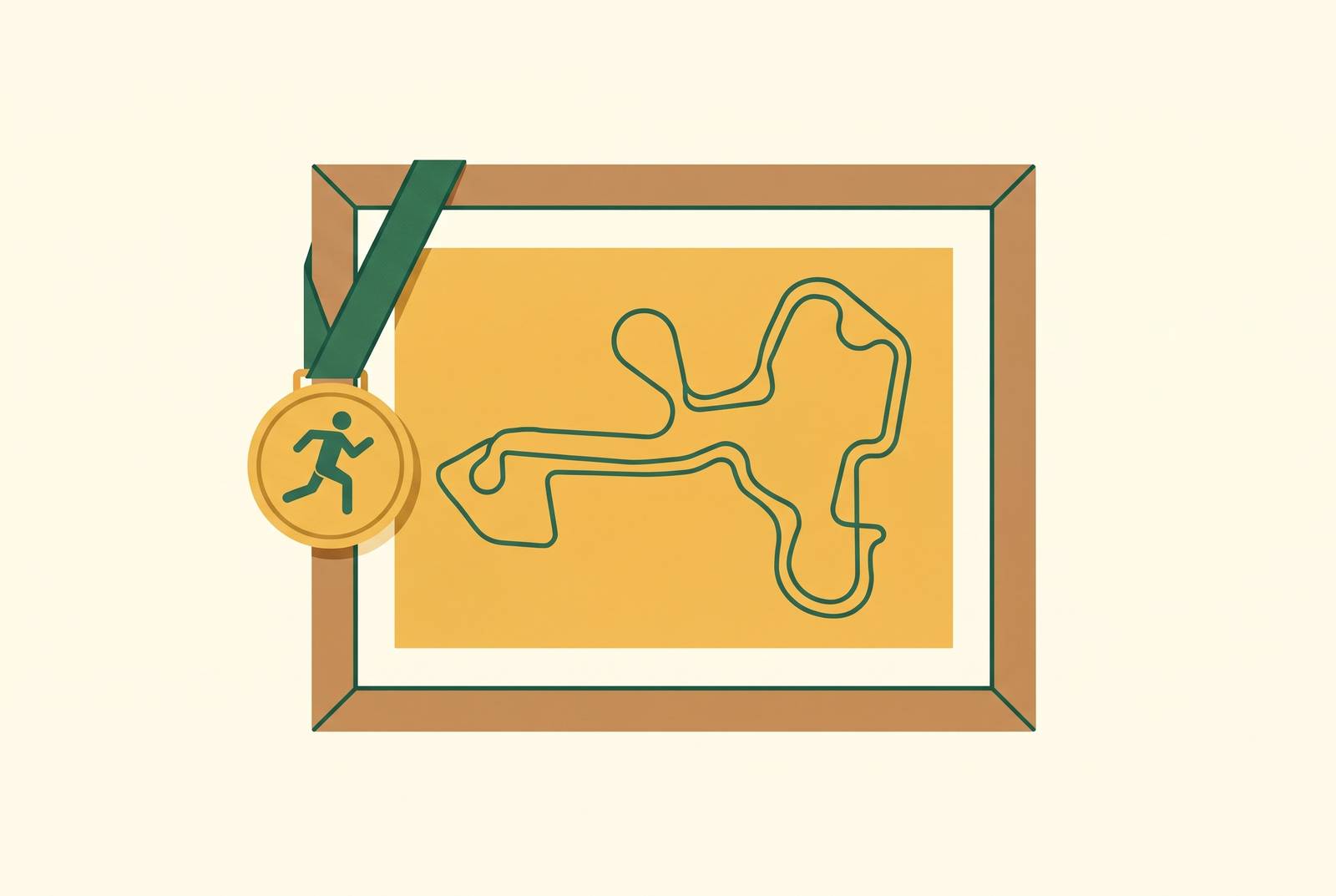
The best personalized gift for a first marathon finisher remembers more than the distance. GPS route art, made-to-order embroidery, training-inclusive wearable keepsakes, and race-artifact displays each preserve a different part of the achievement. The right choice depends more on what the giver knows about the runner’s course, preparation, and attachment to the day than on how prominently an object says “26.2.”
Why a first marathon finish calls for a different kind of gift
A first marathon finish lets others see a commitment the runner made in private. Before that moment came early alarms, skipped social plans, and solo long runs, with no way to know if the training would end as hoped. During the buildup, the runner had to come back several times a week and slowly work up to distances their body had never covered before. The finish is therefore more than an athletic result, because it concludes months spent becoming someone who could reach it.
The medal honors the race, but the finisher’s chute cannot honor every choice that made it possible to start. A gift has room to recognize those decisions. A foam roller or hydration pack can support running without remembering anything about this runner’s experience. The lesson for the gift-giver is to distinguish what will help with the next effort from what will honor the one just completed.
What the generic gift market offers, and why it stops short
An oval “26.2” sticker, a candle with a profane label, or a city-skyline ornament can be a cheerful acknowledgement of the finish. The runner may appreciate it without reservation. These objects express congratulations in a form that is easy to recognize, but their design can belong equally to thousands of finishers. Their limitation is the small amount of this particular runner’s story they can hold.
Engraved glassware, race-name ornaments, and bib-number sweatshirts attach identifying details to an object, yet can still say little about the experience behind those details. The giver can therefore ask whether the gift could only be theirs. A course traced from their activity, a garment made around their result, or a keepsake that includes their training each answers that question differently, with specificity that goes beyond the distance.
GPS route art: turning the course itself into the object
GPS route art uses the geography of a run as the subject of a keepsake. In its most specific form, it replaces a stock illustration of the race course with a route drawn from the runner’s own activity data. That distinction is central to the category. A named race map commemorates where an event took place, while a data-derived route depicts the effort as the runner recorded it. The route is the main feature of the object, with a name and finish time taking less space in the design.
The appeal is grounded in the course itself. Over 26.2 miles, that line was something the runner experienced physically. Turning it into an object gives the race a recognizable outline without relying on a generic city skyline. It also gives the giver a concrete way to acknowledge place. The gift refers to the ground the runner covered, which is a more exact memory than the fact that a marathon happened.
Etsy offers the Chicago Running Route 3D Wooden Map - Personalized Race Gift, a wooden map of that race, with a sale listing and free shipping. Its distinguishing feature is the three-dimensional treatment of the route. The listing establishes a material option for someone drawn to the course as an object, but does not establish that this particular map is generated from an individual GPS file. That difference prevents a false equivalence. A wooden map of a race and art made from a runner’s recorded activity can both mean a lot, even though they differ in how much they show of that runner’s own experience.
For gift-givers, the practical step is to establish what information the chosen service needs. Depending on the service, that may be a Strava activity link, a GPX file, or a known race name. Those inputs are not interchangeable in what they can commemorate. Getting the relevant detail in advance, or asking a running partner who knows the runner’s accounts, connects the intended gift to an actual record. It also makes clear whether the finished piece will represent the shared course or the runner’s own tracked route.
Embroidered and made-to-order objects that carry the race in their making
Embroidery earns its specificity through material and production method. While route art gives the course a shape to look at, embroidery stitches a memory into fabric, stitch by stitch, by hand or machine. The result has texture as well as information. A race name, finish time, and date are sewn into a crewneck or running jacket. That physical integration is part of the gift’s appeal, especially when the runner wants to use the object.
The distinction from a printed garment is concrete. Thread forms the commemorative design within the fabric, producing a durable finish rather than a transfer that can peel or a surface print that can fade. With a made-to-order piece, work begins because someone has chosen these details for this person. The garment can show that care without a full training history, as long as the chosen details capture the achievement the runner wants to remember.
Etsy offers the Personalized NYC Running Sweatshirt, Custom Race Bib 26.2 Runner Shirt, New York Finisher Gift, Running Crewneck, Marathon Gift Ideas with race-bib personalization on a crewneck sweatshirt. The listing has a sale offer and free shipping. Its focus is the bib as an identifying detail. Embroly offers custom embroidered sweatshirts, hats, and accessories with no minimum order, which makes its service available for an individual gift. It also includes a design approval step before production begins, giving the giver a chance to review the proposed design before it is stitched.
Production schedules distinguish these options as much as their designs do. Graceful Embroidery Co. has only two custom spots per month, so it helps to plan ahead. Other made-to-order embroidery shops say they take roughly two weeks to make an order before shipping it, sometimes with rush options, while Embroly gives a 3–5 day turnaround. The giver should establish the current production schedule and shipping time rather than treat a made-to-order garment as if it were already sitting on a shelf.
Wearable keepsakes that hold the training, not just the finish
A training-inclusive wearable keepsake expands the record beyond race day. Most commemorative objects anchor themselves to the course, finish time, or date, which are the details visible when the effort reaches its public conclusion. The runner’s account begins much earlier. It includes the first week of a buildup and the repeated decision to trust a process whose outcome was still unknown. Including that preparation changes the gift’s subject from a completed event to the work that made completion possible.
The defining feature of this format is its use of the runner’s actual training log. Two people can finish the same race while bringing different months of preparation to the start. Their training records distinguish those paths. A keepsake built from that record can therefore hold something that even a carefully personalized race-day object leaves outside the frame.
An object intended for the next long run offers an alternative to a wall display, letting the commemoration accompany continued running. Neither use is inherently more meaningful. For the runner who wants the achievement connected to what comes next, however, a wearable format keeps the memory within the activity that produced it. Its value lies in acknowledging that the first marathon was both a finish and the result of a sustained practice.
Shadow boxes and display pieces for runners who want the artifacts on the wall
A shadow box or medal display preserves the physical evidence of race day. Some runners want the bib, medal, and course map together because those are the objects most directly attached to the experience. The artifacts already have their own history. A display gives them a place and a relationship to one another without translating them into a new image or garment.
Etsy offers a personalized NYC marathon display that has a bib holder, medal hanger, and PB tracker, with a sale listing and free shipping. The tracker adds a personal-best element to the artifact display. Etsy also offers the Modern Hexagon Running Medal Display Holder • Marathon Race Wall Art, which hangs on the wall and has an affordable price. These formats serve a runner who wants the evidence visible. They do not need to include the training log to be closely attached to the person whose bib and medal they hold.
The giver needs access to the artifacts, or the runner must contribute them afterward. Collaboration is often the better fit here. Assembling the display together, or giving a frame the runner fills, respects the role those objects already have in their memory. The result remains anchored to race day by preference.
How to choose a personalized gift for a marathon finisher
The choice depends less on budget than on the information available and the way the runner wants to remember the achievement. For a giver who knows the race name and finish time but does not have activity data, custom embroidered apparel or a personalized race map print fits the available detail. Both can commemorate the result without claiming to reproduce an individually tracked route. Access changes the options. A Strava activity link or GPX file opens the possibility of data-derived route art, while a training record supports a keepsake that includes the buildup.
Physical artifacts point toward a different decision. If the bib and medal are available, a shadow box or display can preserve the objects the runner already values, preferably with their input. Without those objects, an empty frame they fill themselves keeps that approach practical. The intended use also deserves attention. A runner who wants the medal on the wall and a runner who wants a reminder on the next long run are expressing different preferences.
Lead time can narrow the choice further. Digital map prints and lower-production-time embroidery options are the more time-reliable choices when the gift is needed soon, while made-to-order embroidery and custom 3D sculptures require more planning. Embroly’s stated turnaround provides one reference point, but production time is not the same as arrival time. A gift can still feel just as personal when the giver chooses one that can be made in the time they have.
What the runner would want remembered should guide the final choice. It may be the course, the result, the bib they wore, or the months when finishing was still an uncertain prospect. Finding that out is worth the extra step. The strongest gift recognizes not merely that this person completed a marathon, but what completing it meant in the life they had to rearrange to get there.